





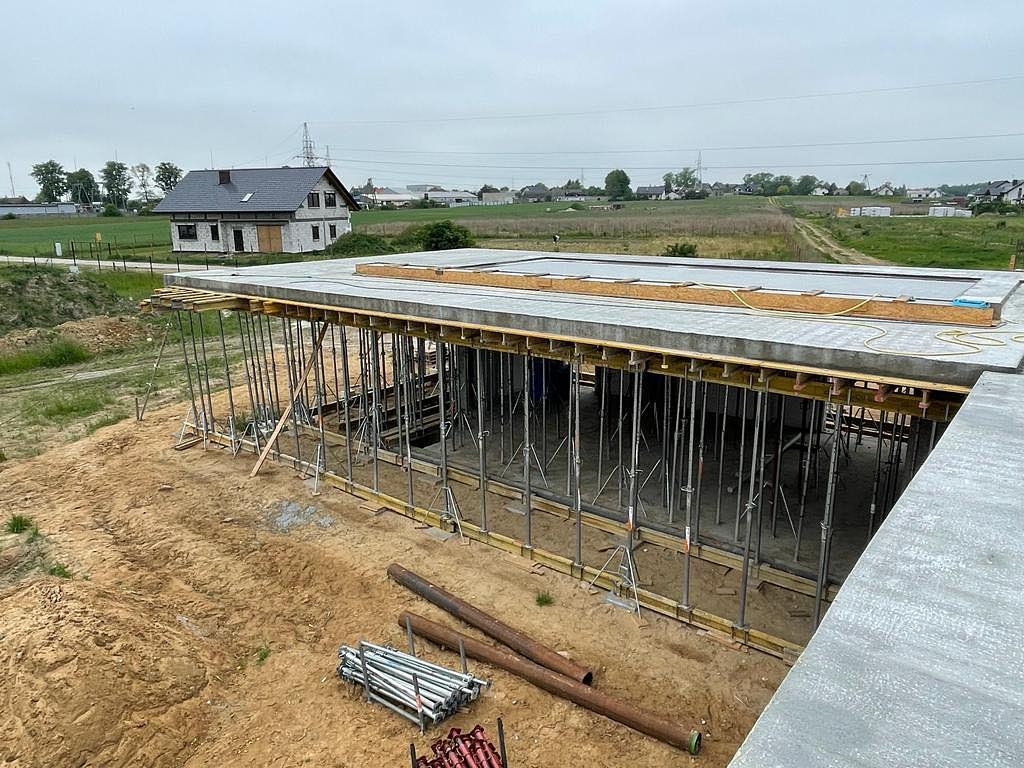
What is the role of slab formwork on a construction site?
Slab formwork can be compared to a baking tray that holds liquid batter in the correct shape until it is baked. In the case of formwork, the batter is usually the reinforced concrete mix, which must harden into a specific form so that the building looks exactly as the architect designed it. The temporary shoring structure also prevents collapse by relieving the load on the whole setup, supporting the weight of the reinforcement and the workers until the concrete reaches its proper strength.
Slab formwork consists of the following elements:
- Formwork lining (forming surface) – the direct layer onto which the reinforced concrete mix is poured; it affects the finish quality of the ceiling (e.g., smoothness). The most commonly used materials are formwork plywood, three-layer panels, and composite panels.
- Supporting structure – the grid underneath the lining that distributes the weight of the concrete mix to the props. Most often, these are girders (secondary girders directly under the panel and primary girders supporting the secondary ones).
- Shoring (temporary foundation) – this includes height-adjustable steel props (shore posts) used to level the slab properly; tripods that stabilize the props during assembly; and heads (cross heads or drop heads) that connect the top of the prop to the girders.
Modern systems are repeatable, modular, easy to assemble, and designed for maximum safety in accordance with occupational health and safety (OHS) guidelines on construction sites.
What works better – manual labor or a mechanized system?
There are three distinct types of slab formwork:
- Modular systems (handset) are a collection of components assembled manually by the construction crew. The entire process can be compared to building with a set of blocks, where every single block has its designated place and specified role, and its absence could compromise the stability and strength of the entire structure. The advantage of this system is its ability to adapt to almost any slab shape. Furthermore, modular systems are lightweight and do not require a crane during assembly. Conversely, their biggest drawback is that assembly is quite labor-intensive because the structure must be completely dismantled after each slab pour and then reassembled from scratch. This flexible solution is typically used for single-family houses or buildings with unusual or complex shapes.
- Slab tables (mechanized systems) are large-area modules where the lining and props are permanently connected to each other. This structure is immediately ready for construction use without needing to spend extra time assembling it. The time saved this way is a clear advantage of this solution, as in practice, the crane does all the work, moving the ready module from floor to floor in just a few minutes without any dismantling required. In this case, however, the advantage is also a disadvantage, as its use requires constant access to a crane, and slab tables are primarily suited for simple and repetitive structures. For these reasons, such a system is rather used in the construction of large-scale buildings, such as skyscrapers, office blocks, or industrial halls.
- Panel systems (intermediate/mixed form) replace girders with ready-made aluminum or composite frames featuring built-in lining. The components are ready-made panels that installers snap into the prop heads. The primary advantages are fast manual assembly and the lack of a need for crane access on the construction site. The greatest asset is safety, as they usually allow panel installation from ground level, eliminating the need for workers to climb onto the formwork before it is secured. The key disadvantage is their modular dimensions, which mean that for highly irregular slab shapes, they require traditional infills. This solution is most frequently used in the construction of residential blocks, where a short floor cycle is critical.
PARAMETER: MODULAR FORMWORK // PANEL FORMWORK // SLAB TABLES
ASSEMBLY TIME: approx. 0.6 h/m² // approx. 0.3 h/m² // approx. 0.15 h/m²
CRANE OPERATION: NOT REQUIRED // NOT REQUIRED // REQUIRED
FLEXIBILITY: MAXIMUM // MEDIUM // LOW
CREW RESOURCES: LARGE (REQUIRES CARPENTERS) // SMALLER (INSTALLERS) // MINIMAL (OPERATOR + SLINGERS)
* The listed parameters are provided based on data from the compared companies.
Comparison of construction market leaders – Doka, Peri, and Hunnebeck.
The first contender for the leader title on the Polish market is the Austrian company Doka Polska Sp. z o.o. (part of the Umdasch AG group), whose history dates back to the 19th century. The company entered Poland in 1996. It builds its construction services on a diverse offer, including options for utilizing various slab formwork configurations supported by system-guided assembly, which eliminates the risk of potential measurement errors. It stands out by placing the strongest emphasis on safety screen systems among its competitors and digitizing planning through 3D graphical models generated from 2D drawings (BIM – Building Information Modeling).
Doka's range includes:
- Modular system (Dokaflex 1-2-4) – based on H20 timber beams and numerically marked beams, allowing props to be set up at safe intervals without using a tape measure.
- Panel system (Dokadek 30) – allows for the safe assembly of large areas directly from ground level.
- Slab tables (Dokamatic) – highly stable units that allow the integration of protective barriers as early as the storage stage.
Next is Peri, founded in 1969 in Germany. It is one of the world's largest manufacturers of formwork and scaffolding. In this case, the company focuses primarily on optimizing working time through lightweight aluminum alloys and early striking mechanisms. Furthermore, it stands out for its exceptionally fast material rotation on-site, reducing the amount of equipment required.
Peri's range includes:
- Modular system (Skydeck) – an aluminum panel system with a drop head that allows panels and beams to be recovered just a few days after pouring, leaving the props behind solely as temporary structural shoring.
- Panel system (Duo) – a system made of technical polymer that can be assembled completely without the use of a crane.
- Slab tables (Peri Table and VT Table) – a lightweight construction based on lattice girders, reducing the load on the crane.
The final candidate on the list is the German-American company Hunnebeck, for which ergonomics and a virtually armored construction, resilient to all conditions, are the most vital factors on a building site. Hunnebeck has operated in Poland for over 25 years, delivering top-quality solutions in formwork, shoring, and safety systems.
Hunnebeck's range includes:
- Modular system (Topec) – a solid girder construction for heavy-duty tasks and high loads.
- Panel system (Topflex) – a system consisting of panels and props with an intuitive assembly scheme.
- Slab tables (Topmax) – tables on a rigid, galvanized steel frame, resistant to extreme wear and impact.
Whom to choose so that the building stands on a solid foundation?
For residential investments, Peri appears to be the most sensible and best candidate due to its work pace and rapid material rotation, which is usually what matters most to future residents. For single-family homes, however, Doka should perform equally well, as it is cost-effective to rent and pays great attention to detail. It will also prove effective for large office buildings or other simple and monumental structures, as it will undoubtedly lower labor costs. Nevertheless, Hunnebeck is highly recommended for such tasks due to the exceptional durability of their systems and a profound focus on safety. The choice of a construction company depends on many variables, and each system performs best with a specific type of structure.