





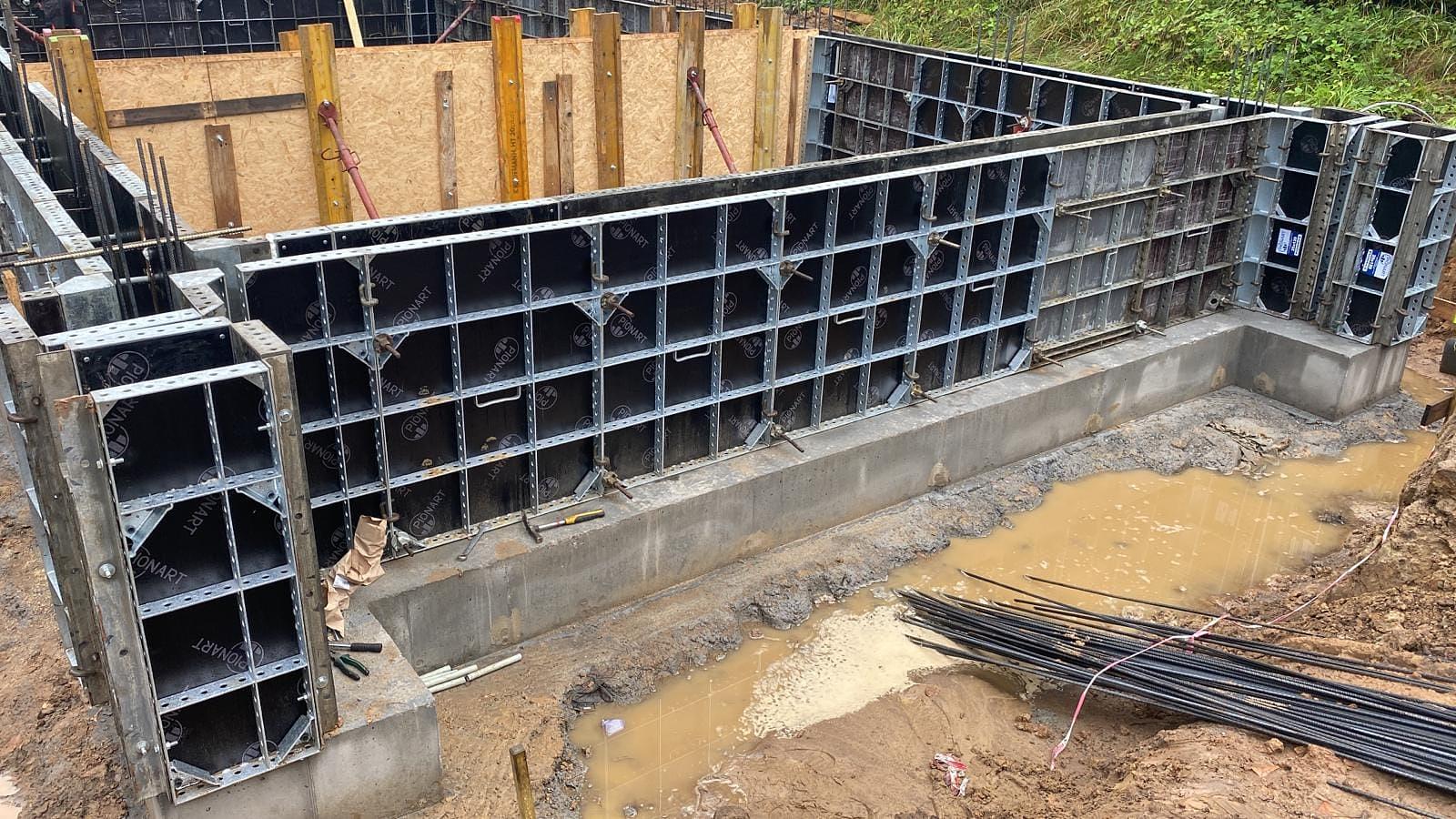
Will there come a moment on your construction site when traditional formwork starts to slow down the work? And is it possible to predict this even before the work begins?
Wall formwork is not always the first choice, but in many projects, it quickly becomes apparent that without it, it is difficult to maintain pace and control over the subsequent stages. In this post, we show specific situations where wall formwork is truly justified.
When is wall formwork essential?
There are moments on a construction site where decisions stem directly from the project design. If wall concreting is required, wall formwork is also required. Without it, it is impossible to give the structure the correct shape or maintain the continuity of work. We see this every day; well-chosen wall formwork organizes the entire stage of work and allows the construction to proceed without unnecessary downtime.
Construction of foundation walls and basements
Foundations are the beginning and, at the same time, a moment where it is easy to make a costly mistake. If the walls are to be poured, the choice is obvious: wall formwork is needed. It is not just about the form for the concrete itself. What matters is that subsequent sections are created evenly and without the need for corrections, as the rest of the construction depends on it.
With basements, there is an additional factor - ground conditions. The walls are higher, they are subject to additional loads, and the work often needs to be carried out efficiently before water appears. Our projects clearly show that wall formwork allows these stages to be completed faster, moving forward without halting the entire investment.
Realization of reinforced concrete walls in residential buildings
Residential construction is changing, and this is very clearly visible. Increasingly, instead of masonry, poured walls are appearing, and with them, wall formwork is becoming a primary tool. This solution works well for both single-family houses and larger investments. First, one wall is built, then the next, and the system works continuously in the same rhythm. From experience, we know that this makes it easier to maintain the pace of work, and the crew does not waste time preparing everything from scratch at every stage.
Industrial structures and engineering facilities
In large investments, there is no room for half-measures. The scale of the work dictates specific solutions, which is why wall formwork is a standard from day one. The whole process relies on a repeatable pattern. First assembly, then concreting, followed by quick disassembly and moving it further. The same set works on subsequent fragments of the facility, allowing for the continuity of work. In such realizations, every delay is felt, which is why well-chosen wall formwork simply keeps the construction moving.
Situations where it is worth considering formwork over traditional methods
Not every project immediately requires systemic solutions, but there are moments when the difference between classic timber formwork and wall formwork becomes noticeable very quickly. It usually starts with minor delays that over time affect subsequent stages. In such situations, changing the technology becomes a way to keep the entire investment under control.
Time pressure and the need to maintain the schedule
There are construction sites where every day matters, especially in developer investments or work carried out in stages. Traditional formwork requires preparation, fitting, and often corrections, which begins to generate time losses with a larger scope. Wall formwork simplifies this process. The elements are ready to use, and assembly repeats according to the same pattern. This makes it easier to plan subsequent stages and avoid situations where one wall blocks further work. In larger projects, such a change can shorten an entire stage by several days.
Repeatability of elements and working within one system
In many projects, repeatability is key. Identical walls, the same heights, the same structural layout. In such an arrangement, manual preparation of forms every single time ceases to make sense.
Wall formwork allows you to work with one set throughout the entire stage:
- subsequent walls are created in the same layout, without dimensional differences,
- the crew works faster because they know the system and do not have to adapt it every time,
- it limits the risk of errors that occur with improvised timbering.
A good example is terraced housing investments or apartment blocks, where the repeatability of the structure is part of the design. Once set up, the system moves from segment to segment without unnecessary breaks.
Limited access to equipment or a smaller crew
Not every construction site allows for the use of heavy equipment. A narrow plot, difficult access, or a limited number of workers can significantly complicate the organization of work.
In such conditions, lightweight wall formwork solves several problems simultaneously:
- it can be assembled manually, without involving a crane,
- it does not require a large number of people for operation,
- it allows work to be carried out even in places with difficult access.
It is often used for single-family houses or smaller investments where flexibility and the ability to operate without extensive technical facilities matter.
How to recognize that wall formwork will be the best solution?
The decision to choose a technology is not always made immediately. It often arises during project analysis or at the construction organization stage. However, there are specific signals that clearly show that wall formwork will not only facilitate work but also help avoid problems in later stages. If several of these occur simultaneously, the choice becomes obvious.
When is it worth choosing wall formwork? Situation analysis
- Projects based on monolithic concrete In situations where walls are poured directly on-site rather than built with masonry units, wall formwork is essential. It provides a stable form that holds its shape perfectly and allows for efficient, staged concreting.
- High requirements for accuracy and precision When a structure must strictly adhere to dimensions and vertical alignment without the need for later corrections, systemic wall formwork is the best choice. It guarantees full repeatability and eliminates the risk of errors typical of manual fitting.
- Limited completion time (schedule pressure) If the investment schedule is tight and does not allow for any downtime, wall formwork becomes crucial. Thanks to the possibility of quick assembly and disassembly, it allows for a high pace of work and a smooth transition to subsequent stages.
- Pressure to reduce labor costs When faced with the need to limit man-hours and optimize team performance, wall formwork performs excellently. It requires significantly less manual labor, which shortens execution time and allows for more effective use of the construction crew.
- Repeatable structural elements If the project involves identical walls or repeatable segments (e.g., in terraced housing), formwork is unrivaled. One set can be used multiple times, eliminating the time wasted on preparing new forms from scratch each time.
- Difficult organizational conditions and smaller crews When access to heavy equipment is limited or you are working with a smaller team, lightweight wall formwork is the ideal solution. Its design allows for manual assembly, enabling professional concrete work without the need for a crane.
Evaluating these factors allows for a quick assessment of the situation. If a project meets even part of these conditions, wall formwork begins to simplify construction management and provides greater control over the entire process.
Conscious choice instead of improvisation
On a construction site, many things can still be changed along the way, but the choice of technology for walls is one of those decisions that impacts the entire course of work. If there is a need to maintain pace, limit errors, and better utilize the crew, wall formwork begins to bring order to the entire process.
At Szalbud, we help select a specific system for the scope of work, not the other way around. Thanks to this, wall formwork is a tool that supports the realization of the investment from the first stage to the completion of the work.