




Choosing the right scaffolding – a decision every investor and contractor must make
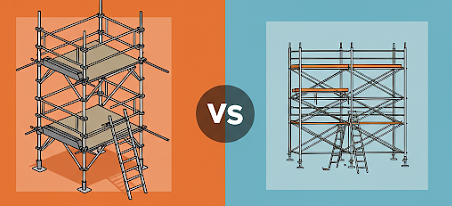
Choosing the right scaffolding is a decision faced by almost every investor and construction contractor. The system you choose determines not only the safety of workers, but also the pace of project execution and the ability to adapt the structure to various needs. Two popular solutions dominate the market: modular scaffolding and frame scaffolding. Each has its supporters as well as specific applications. In the following part of the article, we will compare both systems to help you make the right choice.
Modular scaffolding — the ideal solution for non-standard structures
Modular scaffolding is distinguished by its high flexibility and versatility. Its base consists of vertical posts with connectors that allow the installation of horizontal and diagonal elements in almost any configuration. Thanks to this, the system is very popular wherever standard solutions may not be sufficient. However, like any solution, it has its strengths and weaknesses.
Advantages of modular scaffolding
Why do many contractors and investors choose the modular system? Primarily because of its exceptional adaptability to different working conditions. Here are the key advantages of this solution:
➔ Adaptability to various structures – modular scaffolding can be easily adjusted to complex objects such as chimneys, masts, or façades with irregular shapes. You are not limited by the rigid geometry of frames – you can create structures of any height and width, making this system almost universal.
➔ High stability and load-bearing capacity – modular scaffolding features solid connections between elements, which ensures greater safety when working with heavy materials. For complex structures, stability is a priority, and the modular system performs excellently in this respect.
➔ Versatility of applications – this type of scaffolding can be used in many situations – both on construction sites and in heavy industry or during the renovation of historic buildings.
Disadvantages of modular scaffolding
The decision to choose this system should take into account the specifics of the project, budget, and work schedule. Although modular scaffolding has many advantages, it is worth being aware of its limitations:
➔ Costs – modular scaffolding is an investment that can be expensive, especially if you plan to buy it. Renting is also often more expensive compared to standard frame systems.
➔ Assembly time – the modular system requires slightly more time for assembly and disassembly. In addition, an experienced team is needed to correctly configure the entire structure. For people less familiar with this type of scaffolding, it can be a challenge, which in turn can extend the duration of the work.
Frame scaffolding – a quick and convenient solution on the construction site
Frame scaffolding is one of the most popular and widely used solutions in construction. The entire structure is based on ready-made, prefabricated frames that are connected intuitively. This system works best for standard projects – for example, façade works on flat surfaces of residential, office, or industrial buildings. Of course, like every system, frame scaffolding has both advantages and limitations. It is worth taking a closer look at them to make an informed decision tailored to your project’s specifics.
Advantages of frame scaffolding
Why is frame scaffolding so highly valued on construction sites? The answer is simple – its design is created to maximize ease of assembly and reduce costs. Here are a few reasons why investors and contractors often choose this solution:
➔ Fast assembly and disassembly – prefabricated frames make assembling the scaffolding quick and smooth. Even less experienced teams can easily set up the entire structure in a short time. This is a huge advantage, especially when time is a key factor in project completion.
➔ Lower operating costs – the simple design of frame scaffolding translates into lower purchase and rental costs. It also requires less labor during assembly, which means savings on workforce costs.
➔ Ideal for simple construction work – designed for standard projects such as façade, painting, or plastering works. If you are building a single-family home, renovating a residential block, or performing other works on flat surfaces, this solution will meet all basic requirements.
Disadvantages of frame scaffolding
Although frame scaffolding has many advantages, it is also important to be aware of its limitations. Every system has its own specifics, and one solution does not always fit every situation:
➔ Less structural flexibility – one of the main disadvantages of frame scaffolding is its limited ability to adapt to more complex building shapes. If your project includes irregular façades, protruding architectural elements, or structures with many angles, the frame system may not be suitable.
➔ Limited stability at great heights – although frame scaffolding is stable for typical façade work, it may not perform as well for greater heights or projects requiring high load-bearing capacity.
Scaffolding adapted to the project – frame or modular?
Choosing scaffolding is a decision that can affect the entire course of the construction process. It is the foundation of safe work at height and effective site organization. Therefore, it is not worth basing your decision solely on price – the key is to analyze several important factors that directly influence the project’s progress.
The first factor is the type of structure on which the work will be carried out. If the building has typical, flat façades, speed and ease of use become priorities. However, complex shapes, irregular forms, or buildings with many architectural details require scaffolding that can be flexibly adapted to their form.
Another factor is the project’s timeline. When the schedule is tight, every hour on the construction site matters. Scaffolding that can be quickly assembled and disassembled allows work to start immediately, minimizing preparation time. For longer projects, however, stability and the ability to precisely adapt the structure may be more important, even if assembly takes slightly longer.
Equally important are safety and the type of work performed. Work at great heights, especially with heavy materials, requires a particularly stable structure capable of carrying large loads. In such cases, the load-bearing capacity of the scaffolding becomes key. For simpler, lighter tasks such as painting or plastering, this aspect is less critical, though safety requirements must never be underestimated.
Scaffolding – a key element of construction strategy
The choice of scaffolding is not only a technical decision but also an important element of a construction strategy. Properly selected scaffolding supports the progress of work, ensures crew safety, and helps avoid unnecessary downtime.
There is no single universal solution – each project is different, just like its needs. Sometimes simplicity and speed are the keys to success; other times, precise flexibility proves invaluable. Regardless of which scaffolding you choose, remember that its quality and proper assembly are the foundation that affects both safety and efficiency throughout the entire project.
Because in construction – just like in life – solid foundations mean everything.